Read the Room: Analysing media narratives and what’s behind them.
The Spin: Dissecting a recent comms issue and how to learn from it.
Eyes Up: Opportunities, tenders, and calls for input.
Worth Your Time: Smart finds we’ve bookmarked for you.
Read the Room: One report, four takes
The International Monetary Fund’s Article IV report on Australia landed recently. It’s a dense, 100-plus page health check of the economy that’s full of conditional language, caveats and mid-term policy suggestions. At its core, the IMF said three things.
First, Australia has managed a “soft landing”. Growth has picked up, inflation has eased from its peak, and institutions remain strong.
Second, fiscal settings are broadly appropriate in the near term, with consolidation planned from 2026–27 to rebuild buffers.
Third, there are structural challenges — state debt trajectories, tax system inefficiencies, housing constraints and weak productivity — that warrant reform over time.
That’s the document. But once it hit the news cycle, it became four different stories.
The Australian Financial Review: federation risk and state debt
The Australian Financial Review led with what it described as an “unprecedented warning” that the Commonwealth may need to bail out heavily indebted states. The hook was the IMF’s observation that the federal government is viewed by some credit rating agencies as a “de facto guarantor” of state debt, and that rising sub-national debt could eventually affect Commonwealth borrowing costs.
That language is in the report. But in context, it sits inside a broader, conditional assessment of medium-term fiscal coordination and risk. The IMF also explicitly noted Australia’s AAA rating and the Commonwealth’s improved fiscal position.
However, the AFR piece leaned heavily into the deterioration of state finances — particularly Victoria’s — and added contextual material about infrastructure cost blowouts and corruption investigations that do not originate in the IMF report itself.
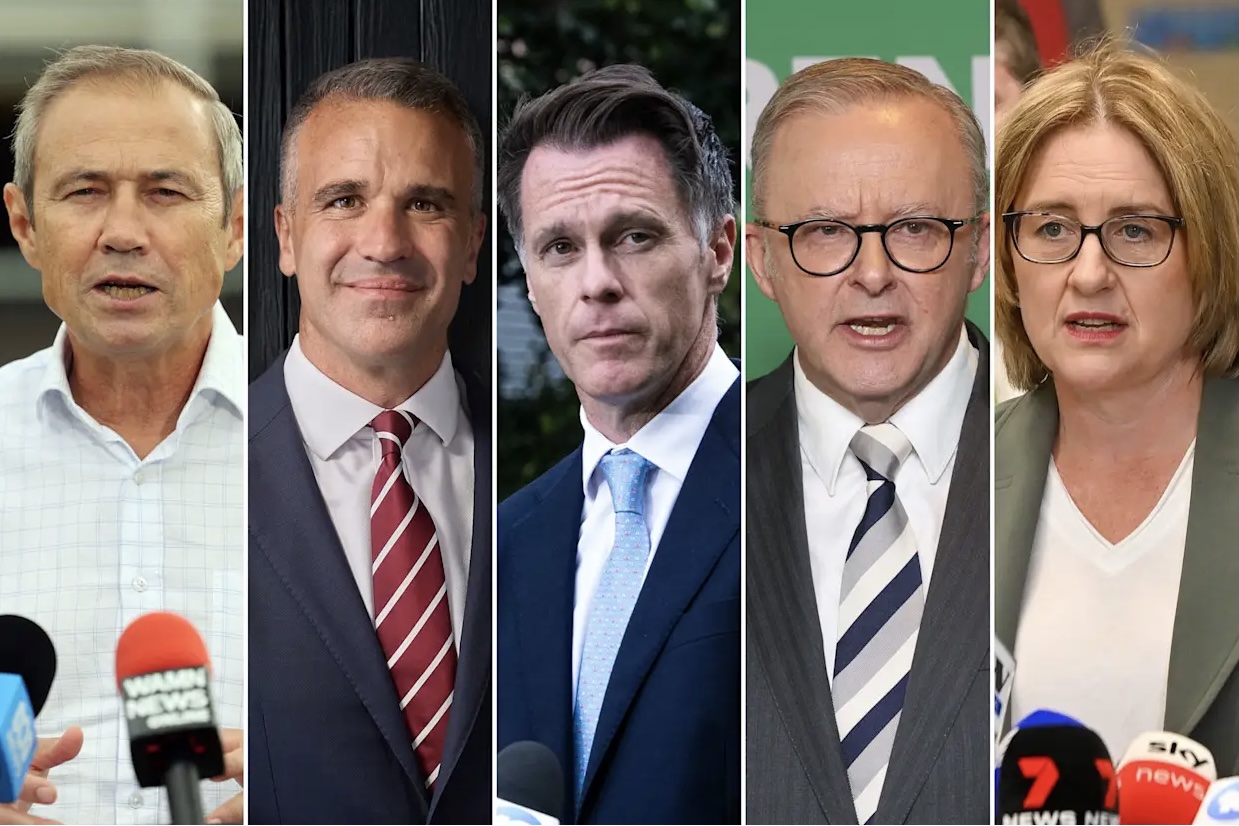
What are the odds? The AFR's all-Labor line-up. Image: AFR
The AFR’s visual framing is also worth noting. The accompanying composite image featured the Prime Minister alongside four Labor state premiers (Western Australia, South Australia, NSW, and Victoria). Yet the IMF report itself singles out debt and spending concerns for the Northern Territory, Tasmania, and Queensland; all of which are non-Labor jurisdictions. For what it’s worth, the odds of randomly picking a full house of Labor leaders from a deck of nine cards is just under 5 per cent.
The overall impression: state profligacy poses a growing national risk, and someone at the AFR is very lucky at poker.
The Guardian: soft landing and endorsement
Guardian Australia's ‘Politics Live’ coverage took a different approach. It emphasised the IMF’s assessment that Australia is managing a soft landing and quoted Treasurer Jim Chalmers describing the report as a “very positive” endorsement.
The structural reform suggestions were mentioned, but not explored in depth. The sharper commentary on state debt and federation reform was largely absent.
The overall impression: the economy is tracking well, with challenges ahead but no alarm bells.
The Sydney Morning Herald: tax reform and the federation
The Sydney Morning Herald chose tax reform as its organising principle. The headline centred on the IMF’s suggestion that Australia could lift productivity and living standards through a comprehensive tax package; potentially including GST reform, changes to capital gains tax concessions, and adjustments to company tax settings.
The report’s commentary on state debt was included, but framed as part of a broader need to reset Commonwealth-state financial relations. This was arguably the most policy-focused treatment of the four, drawing extensively on the tax and federation sections of the report.
The overall impression: the IMF is nudging Australia toward significant structural reform.
The ABC: politics first, policy second
The ABC placed the IMF findings inside a domestic political exchange, specifically a proposal by the new opposition leader for a bipartisan budget repair taskforce and the Treasurer’s response. The IMF’s tax reform suggestions and soft-landing assessment were included but as context for a political debate rather than as the story in their own right.
The overall impression: another front in the budget and tax reform contest.
What didn’t drive headlines?
Across outlets, some IMF themes received relatively little prominence:
• The explicit endorsement of the Commonwealth’s post-pandemic fiscal consolidation.
• Praise for Australia’s institutions, policy toolkit and flexible exchange rate.
• The assessment that the near-term fiscal stance is “broadly neutral” and appropriate.
• The caution that green industrial policy should be narrowly targeted.
These are less dramatic and don’t lend themselves to conflict. But they’re central to the report’s overall tone.
The takeaway
None of the coverage was inaccurate, with each outlet selecting real elements of the IMF report, but each made editorial choices about emphasis. If you only read Guardian Australia’s account, you might conclude the IMF gave Australia a broadly clean bill of health. If you only read the AFR’s, you might reasonably think a federal bailout of the states is looming. If you read the SMH, you’d see tax reform and federation change as the dominant themes.
The IMF report didn’t change between mastheads. Instead, the framing from each outlet did. Short of reading 110 pages of IMF analysis — and who has time for that? — the best defence against selective emphasis is breadth. Reading across outlets isn’t going to eliminate journalistic framing, but it helps you notice it when it happens.
The Spin: Another reason TV is different
Brad Banducci is well known in our media training sessions. We often use his Four Corners interview as an ice-breaker — not to mock him, but because it’s a masterclass in how quickly a television interview can unravel. Participants regularly come back to it throughout the day: “Oh, just like in Brad’s interview.”
So it was interesting to read his recent reflections on that moment. In reporting on a podcast interview (the full version sits behind a paywall), Banducci acknowledged it wasn’t his finest hour. One of the lessons he says he took away? Don’t do a high-pressure television interview at 7am during one of the busiest weeks of the year. That may sound obvious, but it isn’t.
Television operates differently to print and radio. A print journalist doesn’t care where you are. A radio producer mainly wants a quiet room and a stable line. Television wants pictures, context, and atmosphere. Ideally, it also wants symbolism. And if you run a major supermarket chain, where better to interview you than inside a supermarket?
The trouble is that supermarkets are annoyingly full of customers. So if you want clean footage, you film before opening. And suddenly you’re answering difficult questions in a brightly lit store at 7am on the Friday before a long weekend. This is how television works, where the location is an integral part of the story rather than just incidental.
Producers can also be persistent. Very persistent. Years ago, after I’d written an opinion piece, a TV journalist decided they wanted me on camera. I declined — politely and repeatedly — on the basis that I was at work and had no interest in being on television. They turned up at my workplace anyway, secured permission from my boss, and I found myself being interviewed. In my case, the segment never aired. My performance was so wooden they’d wasted their time. But it was an early lesson in how difficult it can be to simply say no once a program has decided you’re part of its narrative.
I’d like to point out here that I don’t do the TV part of our media training. That’s my colleague’s role.
All of which is to say: I have some sympathy for the possibility that Banducci and his team felt significant pressure to agree to that time and location. A 7am interview in a supermarket wasn’t likely an accident.
None of that excuses walking out, of course. Storming off camera remains the moment everyone remembers (and uses as a learning moment).
But it does highlight something executives often underestimate: television doesn’t just capture what you say. It captures how you sit, how you breathe, how you pause, how you react when challenged. Fatigue shows. Irritation shows. Micro-expressions show. And once they’re recorded, they’re part of the story.
When we run media training, complete with “poor old Brad”, we don’t start with “here’s how to answer tough questions”. We start with how journalism works. We talk about the different outlets and their varying audiences. We talk about deadlines and the 24-hour news cycle. We talk about why television needs pictures and why that shapes timing and location. We unpack on-the-record and off-the-record — and why, once a formal interview is under way, assuming you can retrospectively pull a comment back is usually misplaced.
Understanding the pressures journalists operate under doesn’t make interviews easy, but it does help to make them more predictable.
Which brings us to the practical lesson in all of this. If the timing or location feels wrong, push back early. Offer alternatives. Suggest a setting that still serves the visual needs of the program without compromising your ability to think clearly. Credible outlets want you involved since your presence gives the story authority. That gives you some leverage, provided you use it before cameras are rolling. You may not always win, of course, since programs like Four Corners will run stories without you if necessary.
Eyes Up: Opportunities, tenders, and calls for input
The Productivity Commission is calling for submissions as part of its inquiry into GST reforms. An issues paper has been released to guide contributors through the key questions identified at this early stage, and the Commission is explicitly encouraging evidence-based responses — including data, research and case studies. This is an opportunity for businesses, peak bodies and policy specialists to shape the debate around one of Australia’s most politically sensitive tax settings. Initial submissions are due Friday 27 February 2026.
The Joint Standing Committee on Trade and Investment Growth is examining how to create sustainable economic growth in rural and regional Australia, following a referral from the Minister for Trade and Tourism in September 2025. The inquiry spans trade, investment and structural settings affecting non-metropolitan economies. Written submissions addressing the terms of reference are now due by Friday 27 February 2026. Contributors should note that submissions are processed by the secretariat before publication and are not automatically posted online.
In New South Wales, the Public Accountability and Works Committee has self-referred an expansive inquiry into the rapid growth of data centres across the state. The terms of reference cover planning and State Significant Development settings, electricity demand and emissions impacts, water use and cooling, land-use trade-offs (including housing), local environmental and community impacts, economic distributional effects, governance and lobbying transparency, workforce standards, and lessons from other jurisdictions. With a reporting date of 30 September 2026, this inquiry provides a substantial opening for stakeholders in energy, infrastructure, digital industries, housing, water policy and local government to influence how NSW manages the next wave of digital infrastructure build-out.
Worth Your Time: Smart finds we’ve bookmarked for you
Listen: If your comedy sweet spot sits somewhere between affectionate satire and sharp cultural observation, Help I Sexted My Boss deserves a spot in your queue. The premise is simple and brilliant: etiquette expert William Hanson and radio presenter Jordan North — unlikely best friends divided by class, accent and upbringing — tackle listeners’ modern-day dilemmas. William is all polished silverware and place settings; Jordan is unfiltered and proudly “common”. The result is warm, irreverent, often laugh-out-loud banter that feels both anarchic and oddly thoughtful. Regular characters (including the long-suffering Producer Ben, William’s mother Sarah and Jordan’s mum Wendy) add to the running jokes and in-house mythology, while the show’s loyal “G & Divas” community keeps the tone inclusive rather than cynical. It’s silly, yes — but also surprisingly sharp on social codes, manners, and the absurdities of modern life. If you enjoy British humour with a liberal sensibility, this is an easy recommendation.
Read: If you’re not already subscribed to Tidal, now’s a good time to start. In her recent post, '2025 in review, not a minute too soon', Stonefruit team member Aarti Betigeri reflects on a year that combined serious journalism, international travel and the launch of her own Substack platform. While the piece includes personal notes, the through-line is professional momentum: reporting assignments in New Zealand, including an interview with the Prime Minister for Monocle, appearances at writers’ festivals, and publication of long-form analysis for outlets such as the Lowy Institute’s Interpreter. The Substack itself is positioned as a space for considered essays and sharp geopolitical observation; an extension of the thoughtful, internationally literate work she brings to client projects. If you’re interested in clear-eyed political analysis with a global lens, it’s worth adding to your reading list.
Watch: With the 2026 Winter Olympics having wrapped up, the team at Monocle has assembled a timely film list to keep your winter-sport enthusiasm burning. Their selection spans feel-good classics such as Cool Runnings and Miracle, the sharp biographical edge of I, Tonya, and the icy social tension of Force Majeure. Bond fans are catered for too: The Spy Who Loved Me features one of the franchise’s most memorable ski sequences (I’m throwing in a personal favourite, On Her Majesty’s Secret Service for its alpine style alone).
Been forwarded this email and like what you see?
Subscribe here
to get Between the Lines in your inbox every month. If you have a comms issue you want to discuss, we can help.